A corporate roadshow is a peculiar beast. It is not a single event, a conference, or a client dinner. It is a compressed sequence of engagements—investor meetings, analyst briefings, partner discussions, media interviews, perhaps a site visit or two—stacked into two or three days, often in a city the visiting team does not know well. The objective is to deliver a consistent message to a series of audiences in rapid succession, and the margin for error is thin. Arrive late to an investor meeting and the room has already moved on. Miss a slot because of traffic and the entire day’s schedule collapses.
Dubai has become a common stop on corporate roadshows, particularly for companies in finance, technology, real estate, and energy. The city hosts regional headquarters for many multinationals, a dense cluster of institutional investors, and a growing ecosystem of family offices and sovereign-linked entities. A roadshow team might land on a Sunday evening and be in meetings by Monday morning, working through to Wednesday, with five or six engagements per day.
In that context, transportation is not a supporting detail. It is the mechanism that holds the schedule together. This article examines how to coordinate chauffeur transport for a corporate roadshow in Dubai, with attention to the specific pressures that roadshows create: compressed timelines, multiple venues, a travelling team, and the constant risk of slippage.
What Makes Roadshow Transport Different
A roadshow is not the same as a series of ordinary business meetings. Several characteristics distinguish it.
Compression. Roadshows are deliberately intense. The visiting team is in the city for a short window and needs to meet as many counterparties as possible. That means multiple meetings per day, tightly scheduled.
Multiple venues. Meetings are rarely held in a single location. An investor may be in DIFC, a partner in Downtown, a media outlet in Dubai Media City, and a client in Business Bay. Each venue has its own access, parking, and security arrangements.
A travelling team. The roadshow party may include the CEO, the CFO, an investor relations lead, and support staff. They may travel together or split up, depending on the schedule.
Fixed external constraints. Meetings are scheduled around the counterparties’ availability, not the visiting team’s convenience. A meeting cannot simply be moved because traffic is bad.
High stakes. The purpose of the roadshow is to influence decisions—investment, partnership, coverage, or perception. The impression created matters as much as the content delivered.
These characteristics mean that roadshow transport must be pre-planned, flexible, and reliable in a way that ordinary business chauffeur transport does not need to be.
Starting Point: Map the Roadshow Before Mapping the Vehicles
The first task is not to book cars. It is to build a clear picture of the roadshow itself.
Build the Meeting Grid
Create a grid with one row per meeting. Include:
- Day and date
- Start time and end time
- Counterparty name and type
- Venue name and address
- Names of attendees from your team
- Any special requirements—security clearance, media setup, presentation equipment
This grid becomes the master document. Everything else—vehicles, schedules, drivers—is derived from it.
Identify Fixed Points
Some meetings are immovable. A board meeting or a scheduled interview cannot be shifted. Other meetings may have some flexibility. Identifying which is which allows for smarter scheduling.
Map the Geography
Plot the venues on a map. Look for clusters and patterns. Meetings in DIFC and Downtown can often be grouped into a single half-day. Meetings in Dubai Media City and Dubai Internet City are close together. Meetings on the Palm require their own travel time.
Where possible, sequence meetings to minimise cross-city travel. A roadshow that moves from DIFC to the Palm to Business Bay to Dubai Media City in a single day is spending hours in transit. A roadshow that groups venues geographically preserves time for the meetings themselves.
Estimate Realistic Journey Times
For each transition between meetings, estimate the journey time. Use realistic estimates, not optimistic ones. A trip from DIFC to Downtown might take fifteen minutes in light traffic and forty minutes at peak. Build in buffer.
Identify the Gaps
Once journey times are mapped, look for gaps—periods where the team is waiting, or periods where the schedule is uncomfortably tight. Gaps can be used for calls or preparation. Tight transitions need attention.
Deciding the Transport Model
There are three broad models for roadshow transport. The right choice depends on the size of the team and the structure of the schedule.
The Dedicated Vehicle Model
In this model, a single vehicle and chauffeur are assigned to the roadshow team for the duration of the visit. The vehicle remains with the team throughout each day, moving them between meetings and waiting during each engagement.
Best for: Teams of up to four or five people who travel together to most meetings.
Advantages: Continuity, familiarity, and a consistent base between meetings. The vehicle becomes a mobile office and a storage space for laptops, documents, and presentation materials.
Limitations: If the team splits up, a single vehicle cannot serve both groups. Larger teams may not fit in one vehicle.
The Multiple Vehicle Model
In this model, two or more vehicles are assigned, allowing the team to split into subgroups that attend different meetings simultaneously.
Best for: Larger teams, or roadshows where different executives are meeting different counterparties at the same time.
Advantages: Flexibility and parallel scheduling. Two meetings can happen at once.
Limitations: More coordination required. The team must track which vehicle is where, and the schedule must account for both groups.
The On-Demand Model
In this model, a vehicle is dispatched for each meeting or each leg, rather than being dedicated to the team throughout.
Best for: Smaller roadshows with few meetings, or teams that are comfortable with less continuity.
Advantages: Lower cost if the team is not continuously in transit.
Limitations: Less reliability during peak periods, when vehicles are in high demand. No continuity, no mobile base, and more coordination overhead.
For most corporate roadshows in Dubai, the dedicated vehicle model—or a combination of dedicated vehicles—is the most practical. The continuity and reliability it provides are worth the cost.
Choosing Vehicles for a Roadshow
The vehicles must accommodate the team, their equipment, and the image the roadshow is intended to project.
Executive sedans suit small teams of two or three, and are appropriate for investor meetings where a discreet, professional arrival matters. They offer limited space for equipment. The executive vehicle fleet includes options for business travel.
Luxury sedans such as the Mercedes S-Class are appropriate for senior executives—the CEO or CFO travelling separately from the rest of the team, or arriving at a high-profile meeting in a vehicle that reflects the company’s standing.
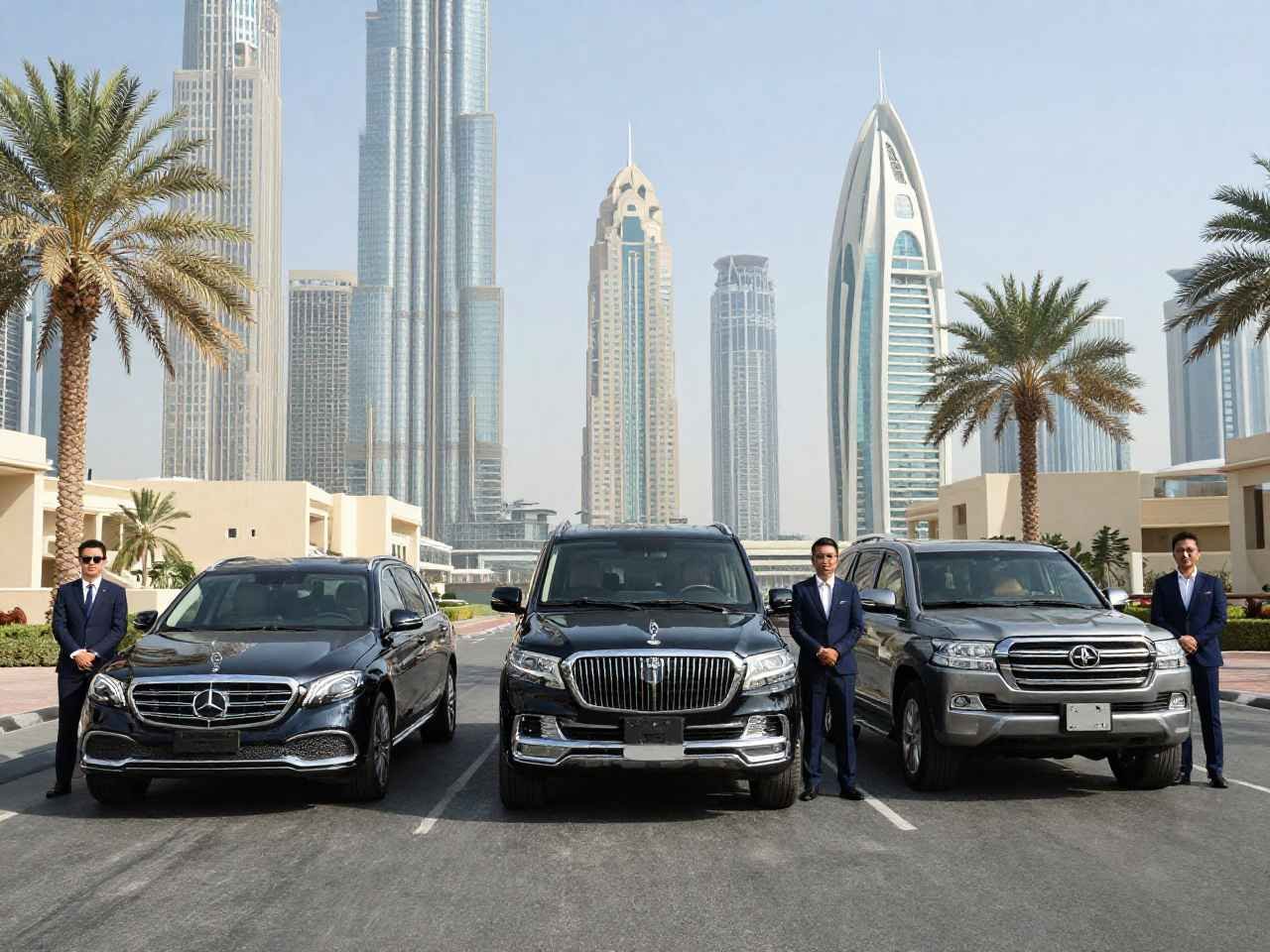
Luxury SUVs accommodate four to five passengers comfortably and offer space for laptops, documents, and presentation materials. They are the practical default for roadshow teams.
MPVs and vans suit larger teams or those carrying significant equipment. They offer space and easy access, though they are less discreet than a sedan. Options such as the Mercedes-Benz Sprinter with chauffeur can accommodate larger travelling groups.
For a roadshow, a common arrangement is one luxury SUV for the main team, with a luxury sedan available for the senior executive when required.
Building the Daily Transport Schedule
With the meeting grid and the vehicle allocation in place, the next step is to build a daily transport schedule.
Work Backwards from Each Meeting
For each meeting, work backwards to determine the departure time from the previous location. Subtract:
- Journey time (realistic, not optimistic)
- Traffic buffer (fifteen to thirty minutes)
- Walking time from drop-off to the meeting room
- Security or reception time, if applicable
The result is the time the vehicle must depart.
Sequence the Day
Lay out the day as a continuous sequence. Identify the departure time for the first meeting, the arrival time, the meeting duration, and the departure time for the next leg. Repeat for each meeting.
Identify Standby Periods
Between meetings, the vehicle waits. These standby periods are not wasted; they are part of the service. The team can use the vehicle as a base for calls, preparation, or rest.
Plan for Lunch and Breaks
Roadshows are intense. Building in a break for lunch or coffee is not optional; it is necessary for the team’s performance. The vehicle can wait at a restaurant or a hotel while the team eats.
Confirm the End of the Day
Identify the final meeting and the expected finish time. Plan the return to the hotel or to a dinner venue accordingly.
Briefing Drivers for a Roadshow
Drivers on a roadshow need more information than drivers on ordinary transfers. A proper brief includes the following.
The day’s schedule. Every meeting, with times, addresses, and contact names.
The team members. Who is travelling, how many, and whether any have specific requirements.
Venue access details. Where to drop off at each venue, and any security or reception procedures.
Contact numbers. For the roadshow coordinator, the team members, and the venues.
Standby instructions. Where to wait during meetings, and how to be reached.
Contingency plans. What to do if a meeting runs over, if a venue is inaccessible, or if the schedule changes.
Vehicle presentation. The vehicle should be clean, presentable, and stocked with water and chargers.
A written brief, shared with each driver, prevents most misunderstandings.
Coordinating Multiple Vehicles
If the roadshow uses more than one vehicle, coordination becomes more complex.
Assign a Coordinator
Designate one person—an executive assistant, an event coordinator, or a team member—to manage transport coordination. This person tracks vehicle locations, adjusts schedules, and communicates with drivers.
Use a Shared Communication Channel
A messaging group that includes the coordinator and all drivers allows for real-time updates. Drivers can confirm arrivals; the coordinator can broadcast changes.
Track Both Teams
If the team splits, the coordinator must track both groups and both vehicles. This requires discipline and clear communication.
Reunite Deliberately
If the team splits during the day, plan where and when they will reunite. This might be at a hotel, a restaurant, or the final meeting of the day.
Handling the Inevitable Changes
Roadshows rarely run exactly to plan. Meetings overrun. Counterparties arrive late. New meetings are added. The transport arrangement must absorb these changes.
Meeting Runs Over
The chauffeur waits. The next meeting may need to be adjusted. The coordinator informs the next counterparty if necessary.
New Meeting Added
If a new meeting is added, the coordinator adjusts the schedule and informs the driver. If the meeting is in a location that conflicts with the existing plan, a decision must be made about priorities.
Meeting Cancelled
If a meeting is cancelled, the team gains time. The driver can be redirected, or the team can use the time for preparation or rest.
Traffic Disruption
If traffic causes delays, the driver should reroute and inform the coordinator. The coordinator adjusts the schedule and notifies affected parties.
Vehicle Issue
If a vehicle develops a problem, the provider should dispatch a replacement promptly. The coordinator informs the team and adjusts the schedule.
The Role of the Mobile Base
One of the most valuable aspects of a dedicated vehicle on a roadshow is its function as a mobile base.
Between meetings, the vehicle provides:
A private space for calls. The team can take calls, join virtual meetings, or discuss strategy without being overheard.
A place to prepare. Presentation materials, notes, and documents can be reviewed and refined.
Storage. Laptops, bags, and materials can be left securely in the vehicle between meetings, rather than being carried to every engagement.
A moment of rest. Roadshows are exhausting. A few minutes of quiet between meetings helps the team maintain energy and focus.
Climate control. In Dubai’s heat, stepping into a cool vehicle between meetings is not a luxury; it is a necessity for maintaining composure.
Drivers should understand that the vehicle is a working space and should maintain a quiet, professional environment.
Cost Considerations
Roadshow transport is typically booked as a full-day or multi-day engagement.
Full-day packages. For each day of the roadshow, a full-day chauffeur booking covering ten hours provides the vehicle and chauffeur for the duration, including waiting time.
Multi-day packages. For roadshows spanning several days, multi-day packages offer continuity and often a discount compared with daily bookings.
Multiple vehicles. If more than one vehicle is required, the cost increases accordingly. Providers may offer discounted rates for multiple vehicles booked together.
What is included. Reputable providers include the chauffeur, vehicle, fuel, tolls within Dubai, parking, and insurance. Waiting time is included within the booked period.
Additional charges. Overtime, inter-emirate travel, and any additional services may be charged separately.
Value calculation. The cost of roadshow transport should be weighed against the value of the meetings themselves. A roadshow that costs a certain amount in transport but secures a major investment or partnership is a worthwhile investment.
A Pre-Roadshow Checklist
Before the roadshow begins, confirm the following.
- Meeting grid complete, with times, venues, and attendees
- Venues mapped and journey times estimated
- Transport model chosen and vehicles allocated
- Drivers briefed in writing
- Coordinator designated and contact details shared
- Communication channel established
- Contingency arrangements in place
- Vehicle presentation standards confirmed
- Multi-day continuity arranged where possible
Conclusion: Transport as the Skeleton of the Roadshow
A corporate roadshow is a demanding format. It compresses a great deal of business into a short window, and it depends on everything running to schedule. Transportation is not the most visible element of a roadshow, but it is the skeleton that holds the schedule together. When it works, nobody notices. When it fails, the entire day is compromised.
Coordinating chauffeur transport for a roadshow in Dubai requires more than booking a car. It requires mapping the meetings, understanding the geography, choosing the right vehicles, briefing drivers properly, coordinating multiple vehicles, and building in flexibility for the inevitable changes. Done well, it allows the roadshow team to focus on what they came to do: deliver their message, build relationships, and achieve their objectives.
For companies running roadshows in Dubai, the transport arrangement is not an administrative detail. It is part of the preparation, and it deserves the same attention as the presentations themselves.
Frequently Asked Questions (FAQs)
Q1: What is a corporate roadshow, and why does it need special transport?
A roadshow is a compressed sequence of meetings—investor briefings, partner discussions, media interviews—held over a short period. It requires reliable, pre-planned transport because meetings are tightly scheduled and cannot be moved due to traffic or logistics.
Q2: How many vehicles does a roadshow need?
It depends on team size. A team of up to five travelling together may need one SUV. A larger team, or one attending parallel meetings, may need two or more vehicles.
Q3: Should the vehicle wait during meetings?
Yes. For roadshows, a dedicated vehicle on standby is essential. It allows the team to move immediately when a meeting ends and provides a mobile base between engagements.
Q4: How do I coordinate transport if the team splits up?
Assign a coordinator to track both groups and vehicles, use a shared communication channel, and plan where and when the team will reunite.
Q5: What happens if a meeting runs over?
The chauffeur waits. The coordinator adjusts the schedule and informs the next counterparty if necessary.
Q6: How far in advance should I book roadshow transport?
Book as early as possible, ideally several weeks in advance. Roadshows often coincide with busy periods, and multi-day, multi-vehicle bookings require coordination.
Q7: What vehicle is best for a roadshow?
A luxury SUV suits most roadshow teams, offering space for four to five passengers and equipment. A luxury sedan may be used for senior executives.
Q8: How do drivers know where to drop off at each venue?
Provide a written brief with the exact venue, entrance, and any security or reception procedures. Confirm these details in advance.
Q9: Can the vehicle be used as a workspace between meetings?
Yes. A dedicated vehicle provides a private space for calls, preparation, and rest between meetings. Drivers should maintain a quiet, professional environment.
Q10: How is roadshow transport priced?
Typically as full-day or multi-day packages, covering the vehicle, chauffeur, fuel, tolls, parking, insurance, and waiting time. Overtime and inter-emirate travel may be charged separately.