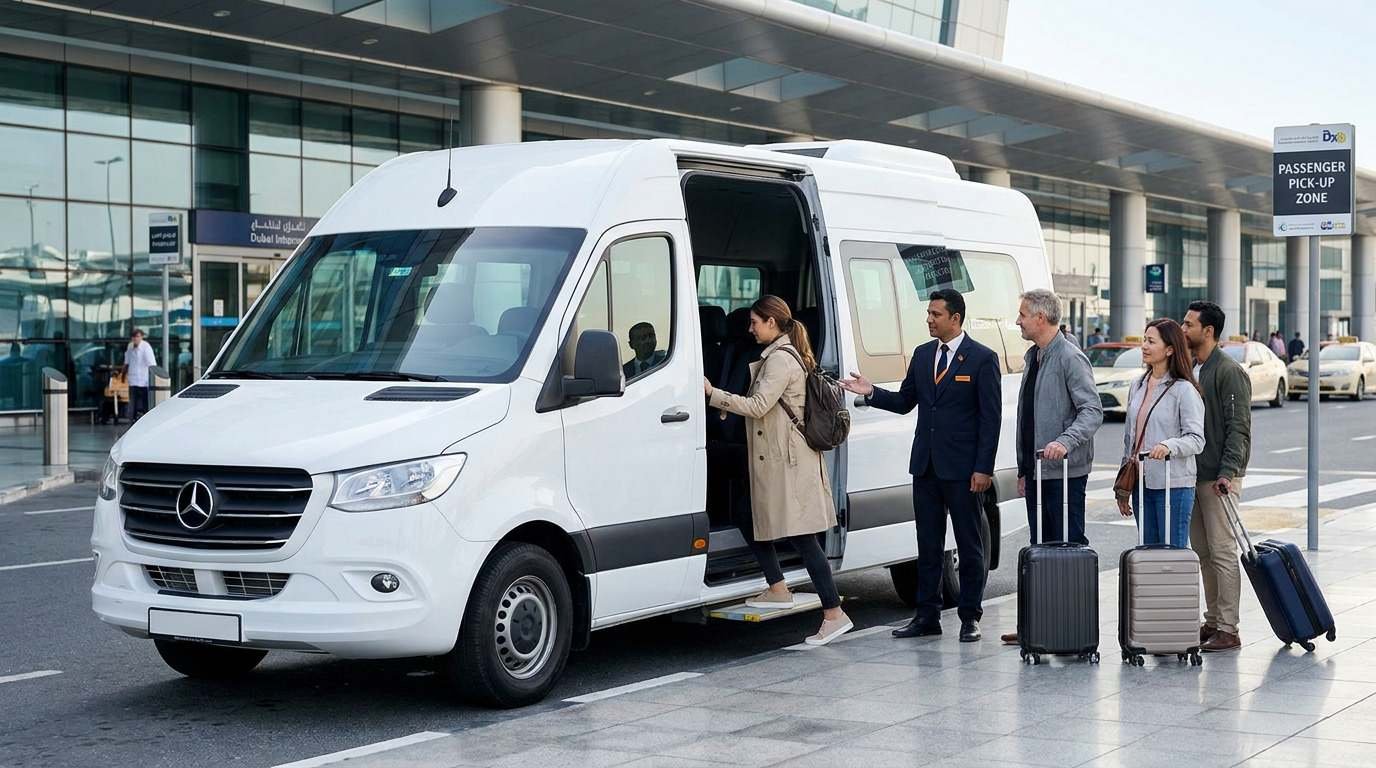
Choosing between a passenger van, minibus and coach can make a significant difference to group travel in Dubai. The right vehicle depends on how many people are travelling, how much luggage they have, the distance they need to cover and the type of journey they are planning.
A passenger van may be suitable for a family or a small group, while a minibus can accommodate a larger party without requiring several separate vehicles. A coach is generally considered for larger groups, organised tours and journeys where passenger seating and luggage arrangements need careful planning.
Although these vehicle categories serve similar purposes, they are not interchangeable in every situation. Understanding their differences can help travellers, families, event organisers and businesses choose transportation that fits their requirements.
What Is a Passenger Van?
A passenger van is a vehicle designed to transport a relatively small group of people in a shared cabin. Depending on the model and seating configuration, passenger vans can range from compact people carriers to larger high-roof vans.
They are commonly used for airport transfers, family journeys, private sightseeing, small corporate groups and hotel transportation.
Main Characteristics of Passenger Vans
Compact group transportation: Passenger vans are useful when a group wants to travel together without hiring several separate cars.
Flexible pickup arrangements: Their size can make them practical for hotel entrances, residential streets and locations where a larger bus may have limited access.
Suitable for shorter journeys: They can work well for airport pickups, local transfers, meetings and sightseeing stops, depending on the group and vehicle configuration.
Variable luggage space: Storage depends on the model, seating layout and number of passengers. A full passenger cabin does not automatically leave enough room for large suitcases.
When Should You Choose a Passenger Van?
A passenger van may be appropriate for a family visiting Dubai, a small group travelling between a hotel and an airport, or colleagues attending a meeting together.
For example, a group with several passengers and only a few small bags may be able to travel comfortably in a suitable passenger van. However, a similar-sized group carrying large airport suitcases may need a different vehicle configuration or additional space.
When comparing options, consider the actual number of passenger seats, luggage dimensions and the length of the journey. The passenger van rental options in Dubai provide a useful starting point for understanding the types of vehicles available for group travel.
What Is a Minibus?
A minibus is a passenger vehicle designed for group transportation, generally offering more seating than a typical passenger van. Depending on its design, it may resemble a larger van or a small bus with a dedicated passenger cabin and a bus-style entrance.
The term minibus does not describe one universal size. Some minibuses are relatively compact, while others can accommodate more than 20 passengers. The exact capacity depends on the vehicle model and seating configuration.
Main Characteristics of Minibuses
Higher passenger capacity: A minibus can be useful when a group is too large for a smaller passenger van but does not require a full-size coach.
Group coordination: Travelling in one vehicle can simplify pickup times, passenger counts and arrival arrangements.
Practical for organised trips: Minibuses are commonly considered for corporate outings, sightseeing groups, school activities, hotel shuttles and private events.
Different seating layouts: Some models prioritise passenger capacity, while others may offer different seat spacing or interior arrangements. Features should be confirmed for the specific vehicle.
When Is a Minibus the Better Choice?
A minibus may be suitable for a medium-sized group attending a conference, a tour group visiting several attractions or a company organising transport for employees.
It can also be an alternative to hiring two smaller vans. However, one larger vehicle is not automatically the better option. The decision depends on the group’s size, luggage, route, pickup locations and the total cost of the journey.
For a group travelling from Dubai to another emirate, for example, passenger comfort and luggage storage may be just as important as the number of available seats.
What Is a Coach?
A coach is a larger passenger vehicle commonly designed for organised group journeys, touring and longer-distance travel. Coaches often have forward-facing passenger seats and, depending on the model, a dedicated luggage compartment beneath or at the rear of the passenger cabin.
Unlike the term minibus, which covers a wide range of smaller group vehicles, coach usually refers to a larger vehicle intended to carry a substantial number of passengers.
Main Characteristics of Coaches
Capacity for larger groups: Coaches can transport larger parties together, depending on the model and registered seating capacity.
Luggage arrangements: Many touring coaches have dedicated luggage bays, although storage capacity varies by vehicle. The presence of a luggage compartment should be confirmed rather than assumed.
Suitable for organised travel: Coaches are often used for conferences, large events, group excursions, staff transportation and tours.
More planning for access: Their larger dimensions may require extra consideration at hotel entrances, narrow streets, parking areas and pickup points.
When Should You Choose a Coach?
A coach can be appropriate when dozens of people need to travel together, such as conference delegates moving between hotels and an event venue or a tour group travelling between cities.
It may also simplify the transport plan by reducing the need for several separate vehicles. However, organisers should confirm the actual passenger capacity, luggage arrangements, boarding requirements and access at every pickup and drop-off location.
For larger organised groups, comparing suitable bus rental options in Dubai can help clarify the differences between available vehicle categories.
Passenger Van vs Minibus vs Coach: Key Differences
The main differences relate to passenger capacity, vehicle size, luggage arrangements, accessibility and the type of journey.
| Factor | Passenger van | Minibus | Coach |
|---|---|---|---|
| Typical group | Small groups | Small to medium or larger groups, depending on model | Medium to large groups |
| Vehicle design | Often van-based | Van-based or small-bus design | Generally a larger touring passenger vehicle |
| Luggage | Depends on cabin layout and storage | Depends on model and seating configuration | May offer a dedicated luggage compartment |
| Common uses | Airport transfers, families and local journeys | Corporate groups, tours and event transport | Conferences, large tours and organised group travel |
| Pickup access | Often more flexible in restricted areas | Depends on vehicle dimensions | May require suitable coach access and parking |
| Longer journeys | Depends on passenger space and comfort | Suitable when the model meets the group’s needs | Often considered for larger touring groups |
| Main consideration | Passengers and bags must fit together | Confirm actual seating and storage | Confirm capacity, luggage hold and access |
These are general categories, not fixed specifications. Some larger passenger vans can accommodate more people than smaller minibuses, and certain minibuses may overlap in capacity with smaller buses. Always compare the actual vehicles rather than relying only on their names.
How Many Passengers Are You Travelling With?
Passenger count is one of the first things to establish when planning group transport. However, the number of people alone does not determine the most suitable vehicle.
A group of eight people travelling with backpacks has different requirements from eight people arriving at an airport with large suitcases. Similarly, a group of 18 people on a short city transfer may have different needs from the same group taking a full-day trip.
Use these general guidelines as a starting point:
- Smaller groups: Compare passenger vans when the actual seats and storage are sufficient.
- Medium-sized groups: Consider a minibus if it provides a practical seating layout and enough space for everyone.
- Larger groups: Compare larger minibuses, buses and coaches according to the actual passenger count and journey requirements.
Count every traveller who needs a seat, including children and accompanying staff. Confirm whether the advertised seating number refers to passenger seats only or includes the driver.
It is also worth allowing some flexibility if the group size may change before the travel date.
Why Luggage Space Matters as Much as Seating Capacity
One of the most common planning mistakes is choosing a vehicle based only on the advertised number of seats.
Luggage can significantly affect the amount of usable space in a vehicle. A passenger van may have sufficient seats for a group but insufficient room for all its large suitcases. A minibus may provide more cabin space without necessarily offering a large separate luggage compartment.
Coaches can be useful for luggage-heavy group journeys when they have suitable storage bays, but the capacity still varies between models.
Before booking, establish:
- The number of large suitcases.
- The number of cabin bags and backpacks.
- Whether passengers will bring pushchairs or mobility equipment.
- Whether sports equipment, musical instruments or event materials are required.
- Whether luggage must remain with the passengers during the journey.
For airport travel, share the approximate number and size of the bags rather than simply stating that luggage will be included. This makes it easier to determine whether the selected vehicle is appropriate.
Which Vehicle Is Best for Airport Transfers?
The best airport transfer vehicle depends on the group size, luggage and pickup arrangements.
A passenger van may work for a small family or group travelling with a manageable amount of baggage. A minibus can be considered when more passengers need to travel together. For larger groups, a coach may be more practical if it has suitable seating, luggage capacity and access to the airport pickup location.
When arranging an airport transfer in Dubai, confirm the following details:
- Passenger count: How many people will travel?
- Luggage: How many large suitcases and smaller bags will the group carry?
- Flight details: What are the arrival or departure time and airport?
- Destination: Is the group travelling to one hotel or several locations?
- Pickup arrangements: Where will passengers meet the driver?
- Additional requirements: Are child seats, accessibility arrangements or special equipment needed?
These details matter because an airport transfer involves more than getting the right number of people into a vehicle. The group and its luggage must be accommodated for the complete journey.
Which Vehicle Is Better for Corporate Events and Group Tours?
Corporate events and sightseeing tours often involve several passengers travelling on a fixed schedule. In these situations, the right vehicle can make coordination easier.
Corporate Meetings and Conferences
A passenger van may suit a small team travelling to a meeting. A minibus can be useful for a larger delegation, while a coach may be appropriate when many employees or conference delegates need transportation together.
For business travel, consider the pickup schedule, luggage or presentation equipment, access to the venue and whether the vehicle needs to wait during the event.
Sightseeing and City Tours
For a small group visiting attractions around Dubai, a passenger van may be suitable if it accommodates the passengers and their belongings. Larger sightseeing groups may benefit from a minibus or coach.
The route also matters. A trip involving frequent stops, narrow access roads or busy hotel entrances may require a different vehicle from a direct journey between two large venues.
A well-planned Dubai city tour should take account of the group size, stop sequence, journey duration and vehicle access before the itinerary is finalised.
Weddings and Special Events
For weddings and private events, passenger vans and minibuses can be useful for transporting smaller groups of guests, while coaches may be considered for larger guest lists.
The choice depends on how many people need transportation at the same time, whether guests are travelling from multiple hotels and how easily the venue can accommodate larger vehicles.
Should You Hire One Larger Vehicle or Several Smaller Ones?
Sometimes one larger vehicle is the simplest option. In other situations, two or more smaller vehicles may be more practical.
One larger vehicle may be suitable when:
- Everyone follows the same itinerary.
- The entire group can be accommodated safely.
- A single pickup and arrival schedule is easier to coordinate.
- The vehicle can access all planned locations.
Multiple smaller vehicles may be suitable when:
- Passengers have different pickup or drop-off points.
- Some travellers arrive at different times.
- The group needs to split between separate destinations.
- A larger vehicle cannot access a particular location.
- The combined luggage load does not fit in one vehicle.
Compare the total cost of the arrangements, including the number of vehicles, drivers, waiting time, route and parking requirements. The lowest individual vehicle price does not necessarily produce the lowest overall transport cost.
What Affects the Cost of a Passenger Van, Minibus or Coach?
The vehicle category is only one factor in the total cost of group transport. Prices can vary according to the vehicle supplied and the terms of the booking.
Common factors include:
Vehicle size and specification: Larger vehicles and different equipment or comfort levels may have different rates.
Booking duration: A one-way transfer, several hours of service and a full-day booking are different transport requirements.
Route and distance: A journey within Dubai may be priced differently from an inter-emirate trip.
Waiting time: Waiting during an event, meeting or sightseeing stop may affect the quoted cost.
Additional pickups and stops: Multiple locations can change the route and the time required.
Luggage and special arrangements: Oversized items or particular accessibility requirements may need additional planning.
When comparing quotes, check what is included, the agreed duration, the route, waiting-time terms and any additional charges. Compare vehicles on the basis of the same itinerary to make the differences meaningful.
Common Mistakes to Avoid When Choosing Group Transport
Assuming all vehicle categories have fixed capacities: Seating arrangements differ by model, so confirm the exact vehicle and passenger seats.
Ignoring luggage requirements: The group may fit into the cabin while its bags do not fit into the available storage.
Choosing a coach for every large-looking group: A coach may be unnecessary for a smaller group, especially when access is restricted or several separate destinations are involved.
Selecting a van only because it costs less: If the group or its luggage does not fit, the arrangement may need to be changed.
Forgetting pickup access: A larger vehicle may not be able to reach every entrance or parking area.
Not confirming the itinerary: Extra stops, waiting time and changes in destination can affect the booking.
Leaving the decision until the last minute: Confirm the vehicle category, actual capacity and luggage requirements before the travel date.
Frequently Asked Questions
What is the main difference between a passenger van and a minibus?
A passenger van is often based on a van design and is generally used for smaller groups. A minibus is intended for group transportation and may offer more seating, with some models using a small-bus layout. Their capacities can overlap, so the actual vehicle specifications matter more than the label.
Is a minibus the same as a coach?
No. A minibus is generally smaller than a touring coach, although capacities vary by model. A coach is usually designed for larger groups and may offer dedicated luggage storage for organised or longer-distance journeys.
Which vehicle is best for a group with large suitcases?
The best option depends on the number of passengers, the dimensions and quantity of the bags, and the vehicle’s storage layout. A larger vehicle is not automatically better unless it offers the necessary usable luggage space.
Is a passenger van suitable for long-distance travel?
It can be suitable if the vehicle provides adequate seating, comfort and luggage space for the group and journey. For larger groups or journeys lasting several hours, a minibus or coach may be worth comparing.
Is one coach cheaper than hiring two passenger vans?
It depends on the vehicle rates, duration, route, driver arrangements and additional charges. Request comparable quotes for the same journey before deciding which arrangement is more economical.
What should I confirm before booking group transportation?
Confirm the actual passenger seats, luggage capacity, vehicle type, pickup and drop-off points, date, duration, waiting arrangements and any special requirements. These details help ensure that the selected vehicle suits the complete trip.
Final Thoughts
Passenger vans, minibuses and coaches all serve useful but different roles in group transportation. Passenger vans are often suitable for smaller groups and flexible local journeys. Minibuses can be practical for medium-sized groups, while coaches are commonly considered for larger parties and organised tours.
The most appropriate vehicle is not necessarily the largest or the least expensive. It is the one that accommodates the entire group and its luggage, suits the route and provides the required seating and comfort for the journey.
By checking passenger numbers, luggage, pickup access, journey duration and the actual vehicle configuration before booking, travellers and organisers can make a more informed decision and avoid unnecessary transport complications.