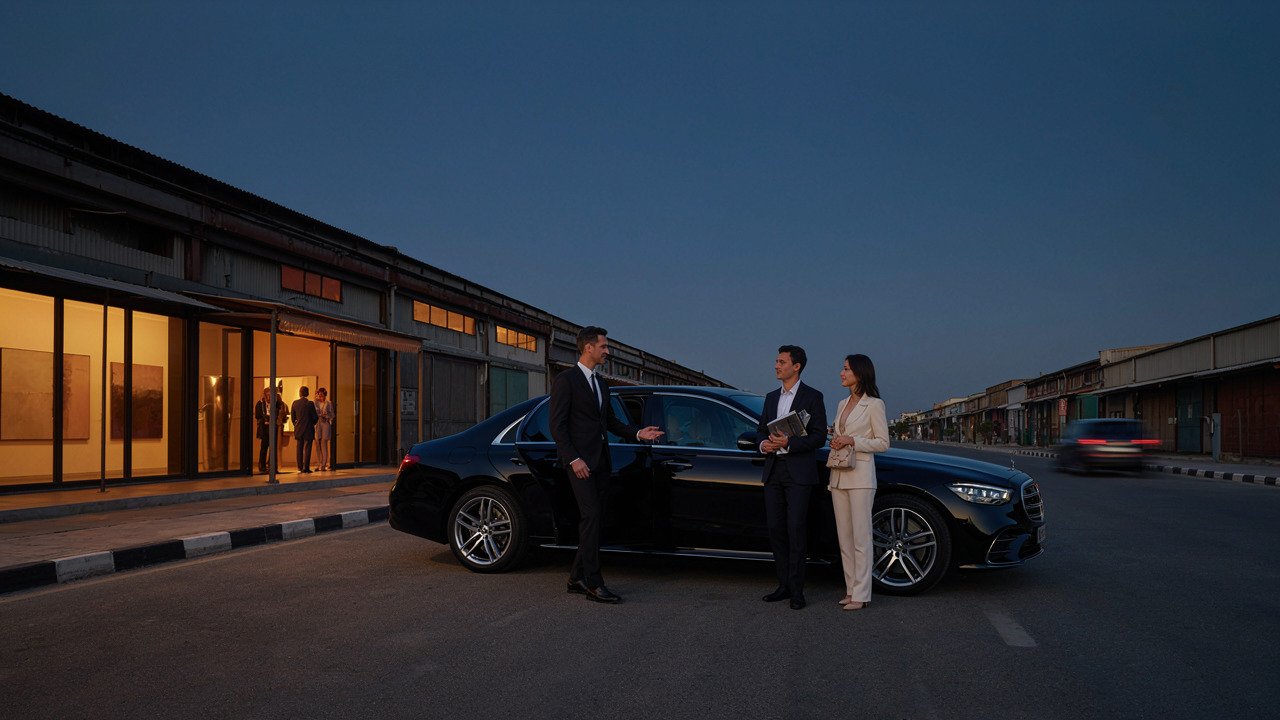
Dubai has become a popular setting for commercial campaigns, branded content, corporate videos, documentaries, television productions and other visual projects. Its modern architecture, luxury hotels, business districts, waterfront locations and distinctive landscapes offer production teams a wide range of filming possibilities.
Behind every successful shoot is a detailed production plan. Directors, producers, camera operators, assistants, stylists, clients and other crew members may need to travel between hotels, studios, offices and outdoor locations according to a tightly managed schedule. When several people must reach the same location at a specific time, reliable transportation becomes an important part of production logistics.
Film production transportation in Dubai involves more than arranging a vehicle for a single journey. Production teams need to consider passenger capacity, pickup coordination, equipment requirements, changing locations, waiting time and the timing of each shooting day.
Chauffeur-driven vans and minibuses can help organise crew movement while allowing production managers to focus on the shoot rather than coordinating every journey individually.
Whether you are planning a commercial advertisement, a corporate video, a fashion campaign or a multi-location production, this guide explains how to plan crew transportation, select suitable vehicles and coordinate journeys around your production schedule.
Why Film Production Transportation Matters in Dubai
A filming schedule often depends on several people and activities coming together at the right time. The camera team may need to prepare equipment before the director arrives, while talent, makeup artists and production assistants may have different reporting times.
If crew members arrive late or travel arrangements are unclear, the production team may lose valuable preparation time. Delays can affect lighting setup, location access, talent schedules and the order of planned scenes.
Organised transportation helps reduce these avoidable complications by establishing clear pickup arrangements and a defined travel plan.
For example, a commercial shoot may involve collecting a crew from a hotel, transporting them to a morning location, moving to another site after lunch and returning selected team members at the end of the day. Planning these journeys in advance makes it easier to communicate expectations to everyone involved.
When selecting a provider, look for clear booking terms, professional drivers, appropriate passenger capacity and the ability to discuss your planned schedule before the shoot begins.
For production teams that require group transportation with a driver, van rental in Dubai is a relevant starting point for comparing available vehicle options.
1. Choose the Right Vehicle for Your Film Crew
The most suitable production vehicle depends on the number of passengers, the length of the journey and the amount of equipment that needs to travel with the crew.
A small commercial shoot may require transportation for a director, a producer and several camera or lighting team members. A larger production may involve multiple departments, clients, talent and support staff travelling between different locations.
Choosing a vehicle based only on its advertised seat count can create problems if passengers also need to carry bags, cases or personal belongings.
Before booking, prepare a passenger list and estimate the luggage or equipment volume. Confirm the usable storage space and the number of passengers the vehicle can legally accommodate.
7-Seater and Luxury MPVs
Smaller MPVs can be suitable for a compact team, a director travelling with assistants or a client group visiting a production location.
They may also work well when only a few people need transportation between a hotel, office, studio or filming site.
However, a vehicle that seats seven passengers may not have enough luggage capacity for several large camera cases. Check the actual seating configuration and storage space before confirming your booking.
11–15-Seater Vans
Medium-sized vans can be useful when several production team members need to travel together.
Depending on the selected model and its approved passenger capacity, these vehicles may suit commercial shoots, interviews, branded content production and small location teams.
A single group vehicle can simplify pickup coordination and reduce the number of separate journeys that need to be arranged.
Larger Vans and Minibuses
Larger passenger vehicles can help when a production has a bigger crew or needs to transport several departments together.
Before booking, confirm whether the chosen vehicle can accommodate the entire group with sufficient space for personal luggage. If the crew is large or equipment volume is substantial, separate passenger and equipment arrangements may be more practical.
You can review the available vans and larger passenger vehicles on the Chauffeur Car Hire Dubai fleet page and confirm which vehicle best matches your requirements.
Important: Passenger vans are not automatically suitable for transporting bulky production equipment. Ask the provider about the vehicle’s permitted use, luggage capacity and any restrictions on carrying equipment.
2. Separate Crew Transportation from Equipment Logistics
One of the most important planning decisions is whether crew members and production equipment should travel in the same vehicle.
A camera department may bring camera bodies, lenses, tripods, monitors, batteries, lighting accessories and protective cases. A commercial production may also require wardrobe bags, styling kits, props and other materials.
Even when a passenger van has enough seats, it may not have enough safe storage space for all these items.
Equipment should be packed and secured appropriately, and passenger seating must not be obstructed. Do not assume that equipment can be placed in an aisle or stacked around passengers simply because the journey is short.
Before booking, consider these questions:
- How many crew members need transportation?
- How many equipment cases will travel with them?
- Are the cases compact, oversized or particularly heavy?
- Will equipment need to remain inside the vehicle during the shoot?
- Does the equipment require specialist handling or secure storage?
- Would a separate, appropriately authorised equipment vehicle be more suitable?
For valuable equipment, the production manager should also establish who is responsible for loading, unloading and checking each item at every location.
If your requirements involve passenger transportation and a separate equipment movement plan, discuss both needs with the relevant transport providers before confirming the arrangement.
3. Coordinate Pickups Around Call Times
A production call time is the time at which a crew member is expected to report for work or attend a designated production activity. It is not necessarily the same as the vehicle’s pickup time.
For example, if a crew must be ready at a location at 7:00 a.m., the transport plan should account for the pickup point, travel time, traffic conditions, access arrangements and a reasonable contingency.
A practical pickup schedule should specify:
- The pickup date and exact location.
- The agreed collection time.
- The number of passengers at each pickup point.
- The destination and expected arrival time.
- The contact person responsible for coordinating the group.
- The procedure for communicating delays or changes.
When crew members are staying at different hotels, decide whether the vehicle will collect everyone along a planned route or whether separate pickups are more appropriate.
Multiple pickups can add considerable time to a journey. Build that time into the schedule instead of assuming every passenger can be collected without affecting the call time.
For early-morning shoots, confirm the booking and pickup details in advance rather than leaving transportation arrangements until the evening before production.
4. Plan Transportation for Multiple Filming Locations
Commercial productions frequently use more than one location to capture different scenes, products or backgrounds. A team might start at an indoor studio, move to an office interior and finish at an outdoor location.
Every location change introduces additional coordination. Crew members must know where they are going, equipment must be accounted for and the vehicle must be available when the production is ready to move.
A useful transportation plan includes a location sequence, estimated departure times, expected journey durations and the person responsible for communicating changes.
Create a location-by-location schedule
Instead of providing only a list of addresses, share the expected movement between locations.
For each journey, record the departure point, destination, estimated departure time, number of passengers and any relevant access instructions.
Allow time for loading and unloading
The time required to leave a location depends on how quickly the team can pack personal belongings and move equipment safely. A departure time should account for these activities.
Confirm waiting arrangements
Ask whether the vehicle will remain available during the shoot or return at an agreed time. These are different arrangements and may have different costs.
Communicate changes promptly
If a scene takes longer than expected or the production changes its order, notify the transport coordinator as soon as possible. Any revised journey or extension should be confirmed with the provider.
For productions with several scheduled journeys, a pre-arranged chauffeur service can make coordination easier than requesting separate transportation at every location.
You can explore Chauffeur Car Hire Dubai’s chauffeur service when planning driver-included transportation for a production itinerary.
5. Account for Dubai Traffic and Location Access
Dubai’s roads connect business districts, residential communities, hotels, studios and outdoor locations, but journey times vary according to the route, time of day and traffic conditions.
A short distance on a map does not guarantee a quick transfer. Peak traffic, roadworks, parking arrangements and access restrictions can all affect the arrival time.
Production managers should therefore plan journeys around realistic travel estimates rather than relying on the shortest possible driving time.
Before the shoot, verify each destination’s exact address and entrance. Large buildings, hotels and commercial developments may have several access points, and the nearest public entrance may not be the appropriate production pickup point.
For outdoor or restricted filming locations, confirm where passenger vehicles are permitted to stop and whether any special access arrangements apply.
A chauffeur should receive clear directions and a designated meeting point. Where possible, provide a map pin or written access instructions instead of relying solely on the name of the location.
Keep a reasonable contingency between travel and the next critical production activity, especially when the team must arrive before equipment setup or talent preparation begins.
6. Arrange Airport Transfers for Visiting Production Teams
International production companies often bring directors, clients, cinematographers, stylists or other specialists to Dubai for a specific project.
Their arrival times may differ, and some team members may travel with additional personal luggage or equipment cases. Coordinating airport transfers in advance helps the production manager organise the first stage of the visit.
When arranging airport transportation, confirm:
- The airport and terminal.
- Flight numbers and scheduled arrival times.
- Passenger names or group details as appropriate.
- The destination hotel or production accommodation.
- The number and approximate size of luggage items.
- The pickup meeting point and contact number.
For larger groups, check whether a single vehicle has enough capacity for everyone and their luggage. Separate transfers may be more practical if passengers arrive at different times or require different destinations.
A Dubai airport transfer service may be relevant when arranging chauffeur-driven transportation between the airport and accommodation or a meeting location.
Confirm the provider’s actual flight-monitoring, waiting and luggage-assistance arrangements before relying on any specific inclusion.
7. Organise Transportation for Directors, Clients and Talent
Not every production participant has the same travel requirements.
A director may need to arrive before the rest of the crew to review the location. A client may attend only selected scenes. Talent may have a separate call time, while a production manager may need to remain available throughout the day.
For that reason, a single transport plan should distinguish between the main crew and people who require separate pickup or drop-off arrangements.
Depending on the production, it may be appropriate to arrange:
- A shared van for the main crew.
- A smaller vehicle for a director or client.
- Separate transfers for talent with a different schedule.
- Airport pickups for visiting personnel.
- Return journeys after the production wraps.
These are planning options rather than a guarantee that every vehicle type will be available from one provider.
The goal is to match the transportation arrangement to the production’s actual requirements without unnecessarily moving every passenger whenever one person’s schedule changes.
If your production requires a more executive style of transportation for clients or visiting directors, compare the luxury chauffeur fleet and confirm the availability of the preferred vehicle.
8. Understand Half-Day, Full-Day and Waiting-Time Arrangements
A film shoot may last several hours, but the transportation requirement can extend beyond the period when cameras are recording.
The vehicle may be needed for an early pickup, travel to the location, a waiting period, a location change and the return journey. If the shoot runs late, the original booking duration may no longer be sufficient.
Before confirming a booking, ask the provider to explain the available service periods and the terms that apply if the schedule changes.
Half-day transportation
A shorter booking may suit a compact production, a limited number of transfers or a shoot with a clearly defined schedule. Check the exact duration included and whether waiting time forms part of that period.
Full-day transportation
A longer booking may be more appropriate when the crew expects multiple location changes or needs the vehicle available across a substantial part of the working day.
Confirm the start and end times, the included hours, the vehicle’s availability between journeys and the cost of extending the service.
Overtime and schedule extensions
Production schedules can change because of weather, retakes, client feedback or technical issues. Ask about the additional hourly rate and how an extension must be approved.
Do not assume a full-day package automatically means unlimited hours, unlimited distance or unrestricted use.
Chauffeur Car Hire Dubai lists half-day and full-day options on its van rental page. Request a production-specific quotation that clearly states the applicable duration, vehicle and service inclusions.
9. Budget for Production Transportation Properly
Transportation costs should be included in the production budget from the planning stage. Comparing quotations only by the headline price can make it difficult to understand the total cost of the required service.
When requesting a quote, provide the transport provider with a clear description of the job.
Include the number of passengers, vehicle requirements, pickup and drop-off points, planned dates, expected service hours and whether the vehicle must remain available between location changes.
Also ask about:
- The total booking price.
- Included service hours.
- Additional hourly charges.
- Waiting time and overtime terms.
- Fuel and Salik or road toll charges.
- Parking charges, where applicable.
- Cross-emirate travel, if required.
- Cancellation and rescheduling conditions.
- Any restrictions on routes or vehicle use.
For a multi-day production, clarify whether each day requires a separate booking and whether the same vehicle can be requested throughout the project.
A written quotation makes it easier to compare providers and obtain approval from the production manager, agency or client.
For a broader comparison of passenger vehicle options, review the Chauffeur Car Hire Dubai fleet listings and ask the company to confirm a suitable arrangement for your production.
10. Safety, Equipment Handling and Professional Conduct
A production team may carry expensive equipment and work under considerable time pressure. Transportation planning should therefore prioritise safe passenger movement and responsible handling of belongings.
Passengers should use designated seats and seat belts. Equipment should be secured appropriately and must not interfere with passenger seating, visibility or safe vehicle operation.
Before loading, designate a person to check the number of equipment cases. Repeat the check when leaving each location, particularly when the team moves between multiple vehicles.
Production staff should also avoid leaving valuable equipment unattended in a vehicle unless secure storage has been specifically arranged and the production’s risk procedures allow it.
Professional conduct matters too. Share accurate pickup information, keep the driver informed of changes and ensure that only authorised people join the transport arrangement.
For overnight shoots or particularly early call times, confirm the service hours and driver arrangements in advance. Do not assume that an existing booking automatically extends into a new working period.
The production manager remains responsible for deciding how equipment is packed, who is authorised to handle it and what additional protection the production requires.
11. Coordinate with Production Permits and Location Managers
Transportation planning and filming permissions are related to the same production schedule, but they are separate responsibilities.
Before filming, the production company should verify the applicable permits, location permissions and any access restrictions relevant to its project. The vehicle provider should be given accurate pickup instructions and any confirmed transport access requirements.
The official Dubai Film and TV Commission filming terms explain the conditions associated with permitted filming activities and locations. Production organisers should consult the relevant official guidance for their specific project rather than assuming a transport booking grants permission to film or enter a restricted site.
A practical pre-production checklist should cover:
- Confirmation of filming locations and authorised access.
- The applicable filming permissions.
- Vehicle pickup and drop-off points.
- Parking and waiting arrangements.
- The crew call sheet and travel schedule.
- The contact details of the location coordinator.
- The procedure for communicating changes on the day.
Sharing confirmed location information early can help prevent confusion when the crew arrives. However, transportation providers should not be expected to secure filming permits on behalf of the production unless that responsibility has been explicitly agreed.
12. Why Chauffeur-Driven Vans Can Suit Production Teams
For many small and medium-sized productions, a chauffeur-driven van offers a practical way to transport several people without requiring each crew member to arrange their own journey.
The driver handles the agreed route while the production team focuses on its schedule. Depending on the vehicle, a van may also be more convenient than multiple smaller cars when passengers are travelling together.
Potential benefits include:
Centralised pickups: A shared vehicle can make it easier to communicate collection times and meeting points.
Group coordination: Team members can travel together when their schedules and destinations align.
Flexible itinerary planning: A booking can be arranged around agreed journeys and service hours, subject to the provider’s terms.
Vehicle choice: Different van sizes can suit different passenger numbers, from smaller groups to larger crews.
Professional driving: Crew members do not need to drive themselves between production locations.
The right arrangement still depends on the actual crew size, equipment requirements, route and schedule. A larger production may need several vehicles or separate transport arrangements for crew and equipment.
For driver-included group transportation, start by reviewing Van Rental Dubai and confirming the vehicle options available for your dates.
13. A Practical Film Crew Transportation Checklist
Before the production begins, use the following checklist to make sure the main transportation details have been addressed.
Before booking
-
Confirm the production dates and daily call times.
-
Count the passengers who require transportation.
-
Estimate the luggage and equipment volume.
-
Identify all pickup, filming and drop-off locations.
-
Decide whether crew and equipment need separate vehicles.
-
Request a quotation for the required vehicle and service duration.
-
Confirm the inclusions, additional charges and cancellation terms.
Before each shooting day
-
Share the final pickup schedule with the relevant crew.
-
Confirm the meeting point and transport contact.
-
Check the day’s location sequence and estimated travel times.
-
Confirm any location access or parking instructions.
-
Make sure passengers know the departure time.
-
Allow time for loading, unloading and equipment checks.
At the end of the day
-
Confirm the final drop-off arrangements.
-
Check that personal belongings and equipment cases have been collected.
-
Notify the transport provider of any approved schedule changes.
-
Record any additional charges or service extensions.
-
Confirm the next day’s pickup arrangements if the production continues.
A consistent process helps production managers keep transport information organised and reduces the risk of last-minute misunderstandings.
Frequently Asked Questions
What is film production transportation in Dubai?
Film production transportation is the arrangement of vehicles and journeys for people working on a filming project. It can include crew transfers, airport pickups, hotel-to-location journeys and transportation between filming sites.
Which vehicle is best for a film crew in Dubai?
The right vehicle depends on the number of passengers, luggage volume and the production schedule. Smaller MPVs may suit compact teams, while larger vans or minibuses may be more appropriate for bigger groups. Equipment requirements should be assessed separately.
Can I hire a van with a driver for a commercial shoot?
You can enquire about chauffeur-driven van rental for your production dates and planned routes. Confirm the available vehicle, passenger capacity, service hours and total price with the provider before booking.
Should film equipment travel in the same van as the crew?
That depends on the equipment volume, vehicle layout and safe storage arrangements. Camera cases and other equipment must be secured properly and must not obstruct passenger seating. Separate equipment transportation may be necessary for larger or specialised loads.
Can transportation be arranged for multiple filming locations?
A multi-location itinerary can be discussed with the transport provider in advance. Share the planned addresses, travel sequence, expected timings and required service duration, and confirm whether the vehicle will remain available between locations.
Can a production book half-day or full-day crew transportation?
Available booking periods depend on the provider and selected vehicle. Chauffeur Car Hire Dubai lists half-day and full-day options on its van rental page. Confirm the included hours, waiting arrangements and overtime charges for your particular shoot.
Does a van rental booking include filming permits?
A transport booking should not be treated as a filming permit. The production organiser must verify the applicable filming permissions and location requirements with the relevant authorities and location owners.
How early should I arrange film crew transportation?
Arrange it as soon as your production dates, passenger numbers and major locations are sufficiently clear. Earlier planning gives you more time to confirm vehicle availability, compare quotations and coordinate pickup instructions.
Final Thoughts
Reliable film production transportation in Dubai starts with a clear schedule, the right vehicle and realistic expectations about travel time. By planning crew pickups, equipment requirements, location changes and service hours in advance, production managers can make transportation easier to coordinate throughout the shoot.
A chauffeur-driven van may be a practical option when several crew members need to travel together. Larger or more complex productions may require multiple vehicles and a separate plan for equipment.
Before booking, confirm the passenger capacity, available vehicle, route, service duration, total price and any special requirements. Keeping these details organised helps the production team concentrate on delivering the shoot rather than resolving avoidable transport problems.
For your next commercial production or filming project, explore Van Rental Dubai and the Chauffeur Car Hire Dubai fleet to review the available driver-included transportation options and request a quotation suited to your itinerary.